
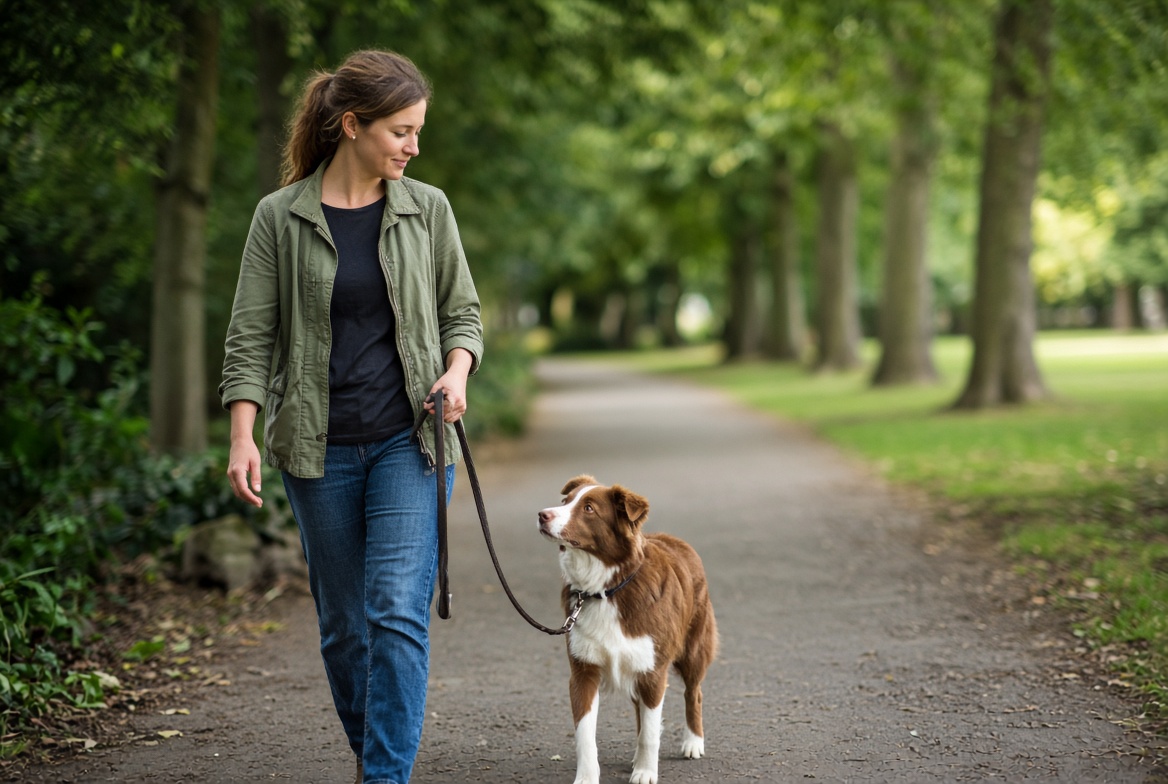
The lead goes tight on the way to the park; once there, calling the dog back becomes another problem entirely. Recall and loose-lead walking share the same outing, but improving one does not automatically settle the other. A useful training enquiry keeps both in view.
These UK dog trainers explicitly offer work on recall and walking on the lead. Their private lessons, residential courses and local programmes give owners different ways to take part. The comparison looks at how those arrangements address the two goals, beginning with TotalK9’s individual and residential services.
Comparing help with everyday walks
Each inclusion has a service addressing recall and walking on the lead. We also considered the practice arrangement, transfer to the owner and the age or time commitments that affect suitability. A broad claim to teach obedience was not enough on its own. Nor does an advertised off-lead goal mean an owner should immediately remove the lead in an unsuitable place.
The order starts with TotalK9’s choice of formats, then contrasts Adolescent Dogs’ owner participation with Platinum K9’s residential obedience. Local coaching and trainer-home arrangements follow. Vislor’s German Shepherd-specific offer and A1K9’s longer stay for older dogs appear later because their fit is narrower. These are editorial choices about service arrangements, rather than measured comparisons of which trainer produces the fastest result.
Top 10 Dog Trainers in the UK for Recall and Loose-Lead Walking
- TotalK9
Recall and lead pulling are both named in the UK pet dog training offered by TotalK9, with individual lessons and residential work providing different ways to address them. That makes it possible to discuss the two difficulties together without assuming they require exactly the same work. A dog that pulls from the front door presents a different starting point from one whose lead manners change only around particular distractions.
The individual route includes the owner and dog working together, at the centre or at home. It puts the person who normally takes the walks into the learning process. Residential training offers another arrangement, with a handover to explain the work when the dog returns. The appropriate format depends partly on how much direct tuition the owner needs and how the training fits the household’s schedule.
Describe an ordinary walk from beginning to end and the enquiry becomes much clearer. Perhaps pulling starts immediately, while recall works until another dog appears; perhaps the outward walk is comfortable and the difficulty begins only on the return. TotalK9’s stated scope covers both skills, so the discussion can keep the separate starting points visible while choosing a workable lesson or residential arrangement.
- Adolescent Dogs
Adolescent Dogs offers individual lessons alongside residential training, and names recall and lead manners among its training goals. Its reward-based approach gives an owner a practical subject to explore: what the dog is responding to and how that response will be encouraged during ordinary walks.
The private route is attractive when the owner wants to practise with the trainer present. Residential work changes the arrangement by giving the dog a period with a professional before the owner takes over. The choice can depend on where the difficulty lies. Someone who struggles to recognise the right moment to reward will have a different learning need from someone arranging a broader period of training. Adolescent Dogs provides both formats, allowing the walking goals to be considered within the actual time and participation available.
- Platinum K9
Platinum K9 puts recall and lead walking within residential obedience training. This suits an owner considering sustained work on both skills during a stay, rather than booking one isolated walking lesson. The two goals still deserve their own place in the agreed programme: a comfortable lead does not establish a reliable recall, and returning promptly says little about the journey there.
Its owner teaching connects that residential work with the walks taken afterwards. The useful outcome of the handover is an explanation of what has been practised for each skill and how the owner will carry it on. That is a more precise basis for judging the service than expecting a generally better walk after collection.
- Millen K9 Services
Millen K9 Services offers one-to-one work on recall and loose-lead walking in Halifax. For a nearby owner, the advantage is the ability to return with observations from actual walks and receive further guidance. The trainer’s remit covers both goals, so progress in one need not obscure an unresolved difficulty in the other.
Picture the approach to a favourite park. The quiet street may be easy, while the final stretch brings pulling. Millen’s private appointment gives that change of setting time and attention without losing recall from the agenda. A nearby owner can return with observations from the same familiar route, making the next lesson a continuation of actual walks rather than a fresh account of a broad obedience problem.
- Liberty K9
Five hours across four private sessions gives Liberty K9’s programme a useful shape for owners working on everyday walks. The first two-hour meeting includes discussion and practical work, with subsequent sessions taking place within an eight-week period. Its stated scope includes pulling and recall.
There is time between Liberty’s appointments to discover what happens on the familiar route. The next session can address the part that remained difficult, whether that was responding to a recall or keeping the lead comfortable. Weekday attendance near Nantwich is required, so the programme suits an owner able to make repeated visits. Its appeal is this cycle of a substantial first meeting, practice and feedback over a defined period.
- Infinity K9
Infinity K9 takes residential dogs into a trainer’s home and includes recall and lead walking among the goals it addresses. For a household seeking help with walking as part of a wider everyday routine, that setting offers a distinct alternative to a dedicated boarding centre.
The assessment can distinguish a recall that works only in familiar surroundings from one that needs developing from the beginning. Lead walking has its own starting point too: constant pulling and a sudden surge in one place are different accounts for the trainer. Infinity’s home setting makes most sense where the owner is considering walking within a wider period of work on daily routines. Collection across much of England may make that route practical beyond the immediate area, with the address agreed for the booking.
- CK9 Training
CK9 Training gives owners in Surrey and South London a local option with both recall and loose-lead training in its service range. Its area includes Ewell, Epsom, Banstead and Streatham. For someone who wants regular attendance close to home, this is a different proposition from sending the dog away for several weeks.
A local programme allows the owner to decide which goal needs attention first. Someone whose dog already returns readily in familiar settings may want more work on the lead; another may need a plan that gives both equal attention. CK9’s named offers allow that choice to begin with the service itself. Staying nearby also keeps ordinary walks between appointments, so the next lesson can pick up from what actually happened on the route.
- Extremus Dog Training
Extremus offers individual dog tuition and residential programmes in Carmarthenshire, with recall and loose-lead walking explicitly covered. Its residential Foundation and Focus programme provides a two-week starting option; the broader four-week programme includes work in public settings. Those distinctions matter when comparing the scope of a stay.
An owner who lives nearby may prefer to remain directly involved through lessons. Someone considering residential training can compare the programme’s stated setting and length with the situations in which help is needed. Extremus also describes a half-day handover with personalised notes, giving the residential route a concrete owner-learning component. The choice is therefore between actual arrangements for practising and transferring these skills, rather than simply between a shorter and longer booking.
- Vislor
German Shepherd owners have a specifically documented route at Vislor. Its material on training the breed expressly offers help with recall and loose-lead walking, alongside its wider individual and residential services. That is the basis for including it here; a breed-focused offer should retain its stated scope.
That narrower scope can be useful to the German Shepherd owner already looking for tuition with these walking goals. The centre and lesson format still matter, because breed does not explain the circumstances in which a lead tightens or a recall fails. Vislor provides a documented route for this reader; the enquiry then moves from breed to the actual walk, with both skills retained as separate subjects for the trainer.
- A1K9
A1K9’s residential pet training near Swansea explicitly covers recall and walking to heel on and off the lead. The advertised course lasts four to five weeks and requires a fully vaccinated dog older than ten months. These conditions make it a different decision from a puppy class or a single private appointment.
The length and age threshold make this a substantial commitment for an eligible older dog. There is also a useful distinction in the walking language: A1K9 names heelwork, which the owner should relate to the kind of everyday lead walking sought. The programme explicitly includes recall as well, so both goals can be discussed within one defined pet-training course. Its separate protection-dog supply business is not the service being compared here.
A clearer starting point for the first conversation
Separate the two goals when describing your dog. Note where recall already works, where it changes and what happens on the lead before and after a distraction. This gives the trainer more to work with than the phrase bad on walks.
Bring that account to a trainer whose appointments you can use. Repeated local lessons and a sustained residential course organise the work differently, but both need a clear idea of what is being practised. Keep recall and the lead separate when discussing progress; a good week with one skill should not make the other disappear from the plan.
Source note: Official dog-training service pages, residential programme descriptions, individual lesson information and stated admission requirements informed this comparison.


